
If your dentist has mentioned a dental crown or you’ve been putting one off, you’re not alone. Many patients arrive at Harter Family Dental with questions about what crowns actually do, how the procedure works, and whether it’s truly necessary. This guide answers all of that, so you can make an informed decision about your smile.
What Is a Dental Crown?
A dental crown is a custom-made cap that fits over the entire visible portion of a tooth — from the gum line up. It restores the tooth’s original shape, size, strength, and appearance, effectively protecting what remains of a natural tooth while functioning like a healthy one.
Crowns are one of the most common and versatile restorative dental treatments available. They can be made from several materials, are designed to last 10–15+ years with proper care, and when placed by an experienced dentist, look virtually indistinguishable from your natural teeth.
At Harter Family Dental, Dr. Harter combines his clinical expertise and artistic eye to ensure every crown we place blends seamlessly with your smile.
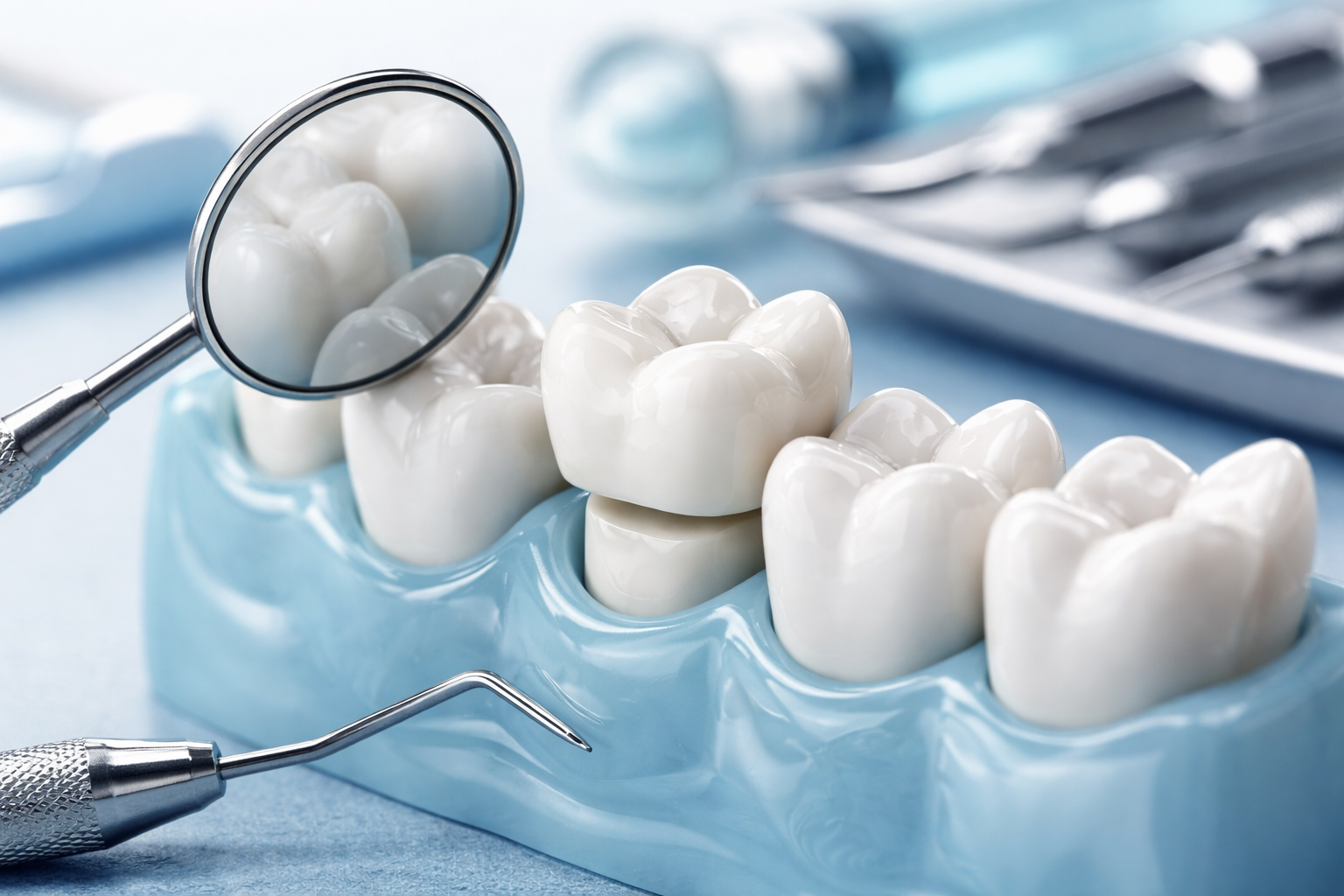
When Does a Dentist Recommend a Dental Crown?
Not every dental problem requires a crown but in certain situations, a crown is the most effective and lasting solution. Here are the most common reasons Dr. Harter may recommend one:
After a Root Canal Treatment
Root canals remove infected pulp from inside a tooth, which can leave the remaining structure brittle and vulnerable to fracture. A crown is placed over the tooth to protect it and restore full function. Without a crown, a root canal-treated tooth is significantly more likely to crack or break.
Large Cavities That a Filling Can’t Adequately Restore
When decay is too extensive for a filling to reliably hold or when a previous filling has failed, a crown provides full coverage and structural support that a filling simply can’t offer. Trying to patch a severely compromised tooth with a filling often leads to further breakdown.
Cracked, Broken, or Severely Worn Teeth
Cracks in teeth can be painful and unpredictable. A crown holds the cracked tooth together, preventing the crack from spreading deeper toward the root. Similarly, teeth worn down from grinding (bruxism) or trauma can be rebuilt and protected with a crown.
Strengthening a Weakened or Structurally Compromised Tooth
Sometimes a tooth has lost so much natural structure through decay, previous dental work, or fracture — that it can no longer function reliably on its own. A crown provides the reinforcement needed to keep the tooth in service long-term.
If you’re experiencing pain, sensitivity, or have been told you need a crown, don’t wait. Delaying treatment almost always makes the problem more complex and costly.
The Dental Crown Procedure: Step by Step, Start to Finish
One of the most common concerns patients have is simply not knowing what to expect. Here’s exactly what happens when you get a crown at Harter Family Dental:
Step 1: Examination and Tooth Preparation
Dr. Harter begins with a thorough evaluation of the tooth and surrounding structures, often including digital X-rays. The tooth is then gently shaped, a small amount of enamel is removed on all sides to create room for the crown to fit precisely. Local anesthesia ensures you remain comfortable throughout.
Step 2: Digital Impressions or Scans
We use modern digital impression technology to capture a precise 3D model of your prepared tooth and bite. This eliminates the discomfort of traditional putty impressions and results in a more accurate crown fit.
Step 3: Temporary Crown Placement
While your permanent crown is being fabricated at a dental lab, a temporary crown is placed to protect the prepared tooth. You’ll wear this for approximately 2–3 weeks. Avoid very sticky or hard foods during this time.
Step 4: Final Crown Placement
When your permanent crown is ready, you return to our office. Dr. Harter checks the fit, bite alignment, and appearance before permanently cementing it in place. Minor adjustments can be made chair-side to ensure everything feels natural.
Step 5: Comfort and Recovery
Most patients experience little to no discomfort after a crown procedure. Mild sensitivity around the tooth and gums is normal for a few days and typically resolves on its own. Over-the-counter pain relievers are usually sufficient if needed.
Types of Dental Crown Materials
The material used for your crown affects its appearance, durability, and cost. Dr. Harter will recommend the best option based on the tooth’s location, your bite, and your aesthetic goals.
Porcelain and All-Ceramic Crowns
These offer the most natural appearance and are an excellent choice for front teeth where aesthetics are a priority. They are highly biocompatible and ideal for patients with metal sensitivities. Modern all-ceramic crowns are also quite durable.
Zirconia Crowns
Zirconia has become the gold standard for many patients. It combines exceptional strength with a tooth-like appearance making it suitable for both front and back teeth. Zirconia crowns are highly resistant to chipping and can last well beyond 15 years with good oral hygiene.
Porcelain-Fused-to-Metal (PFM) Crowns
PFM crowns offer a balance of strength (from the metal core) and aesthetics (from the porcelain exterior). They have a long, proven track record. One consideration: over time, the metal margin may become visible at the gum line, something worth discussing with Dr. Harter.
Typical Lifespan and Durability Factors
With proper care, most dental crowns last 10–15 years or longer. Factors that affect longevity include:
- Oral hygiene habits such as brushing, flossing, and regular cleanings
- Whether you grind your teeth (a night guard can significantly extend crown life)
- Dietary habits — avoiding excessively hard foods
- The location of the tooth and the forces it endures
- Material quality and lab craftsmanship
How Much Do Dental Crowns Cost in Cape Girardeau?
The cost of a dental crown varies depending on several factors:
- Material selected (zirconia and all-ceramic tend to cost more than PFM)
- Which tooth is being crowned (back teeth require more structural strength)
- Whether additional procedures like a build-up or root canal are needed beforehand
- Your specific insurance plan and coverage
Most dental insurance plans cover a portion of crown costs when the crown is deemed medically necessary which is the case in most of the situations described above. Our team will help you understand your benefits and submit claims accurately.
Here’s the financial reality many patients don’t consider: delaying a crown almost always increases cost. A tooth that needs a crown today may need an extraction and a more expensive implant six months from now if it fractures or becomes infected. Early treatment is almost always the more cost-effective choice.
Call our office at (573) 335-4646 and our team will be happy to go over estimated costs and financing options before you commit to any treatment.
What Happens If You Delay a Recommended Crown?
We understand dental treatment can feel like something to put off. But when a crown is recommended, waiting carries real risks:
- Tooth fracture — A weakened tooth can crack unpredictably, sometimes splitting below the gum line where it can no longer be saved
- Infection and abscess — Structural compromise can allow bacteria to reach the pulp, requiring emergency root canal treatment or extraction
- Loss of the tooth — If a tooth breaks severely or becomes infected, extraction may become the only option
- Significantly higher costs — Replacing a lost tooth with an implant, bridge, or partial denture is far more expensive than placing a crown when it was first recommended
The bottom line: if Dr. Harter recommends a crown, there’s a clinical reason for it. Addressing it promptly protects the tooth, your health, and your wallet.
Trusted Local Dentist for Dental Crowns in Cape Girardeau
If you’re looking for a dentist in Cape Girardeau you can genuinely trust, you’ve found one.
Dr. Harter was born and raised right here in Cape Girardeau. He completed his Doctorate of Dental Surgery at the University of Missouri-Kansas City School of Dentistry in 2012. After training and working elsewhere, he returned home in 2014 to take over the practice of longtime local dentist Dr. John Freeze because this community is where he belongs.
That hometown connection isn’t just a talking point. It shapes how Dr. Harter practices dentistry. “I treat every patient as if I were treating my own family,” he says and his team operates with that same standard. Dr. Harter is an active member of the American Dental Association, the American Academy of Cosmetic Dentistry, the Missouri Dental Association, and the Southeast Dental Society.
Harter Family Dental also offers state-of-the-art and comprehensive dental services in a warm, family-friendly environment. If you’ve been told you need a crown or you have a tooth that’s been bothering you, the right time to address it is now.Call us at (573) 335-4646 to schedule your crown evaluation, or request an appointment online. Early treatment saves teeth and money.
Frequently Asked Questions About Dental Crowns
Does getting a dental crown hurt?
The crown procedure itself is performed under local anesthesia, so you should feel pressure but not pain. Some patients experience mild sensitivity or gum soreness in the days following the procedure, which typically subsides quickly. Dr. Harter’s team is known for their gentle, patient-centered approach. Many anxious patients are genuinely surprised by how comfortable the experience is.
How long does it take to get a dental crown?
The crown process typically involves two appointments spaced 2–3 weeks apart. The first appointment (preparation and impressions) takes about 60–90 minutes. The second appointment (permanent placement) is generally shorter around 30–45 minutes. Some practices offer same-day crowns with in-office milling technology; ask our team about current options.
Can a dental crown fall off?
It’s uncommon, but it can happen especially with temporary crowns. Permanent crowns are cemented securely and rarely come loose. If a crown does come off, save it and call our office right away. Do not try to recement it yourself. Causes include decay underneath the crown, a bite that places unusual stress on the crown, or a compromised cement bond over time.
Do dental crowns look natural?
Yes, especially modern zirconia and all-ceramic crowns, which are matched to the color, shape, and translucency of your surrounding teeth. Dr. Harter’s background in cosmetic dentistry and his attention to aesthetics means your crown will look like it belongs. Most people won’t be able to tell the difference between a well-placed crown and a natural tooth.
Is a root canal always required before getting a crown?
No. A root canal is only required when the tooth’s pulp (inner nerve and tissue) is infected, inflamed, or at risk. Many crowns placed on teeth that are structurally compromised but have healthy pulps, cracked teeth, large cavities, or broken teeth can all receive crowns without a root canal. Dr. Harter will assess the vitality of the tooth during your exam.